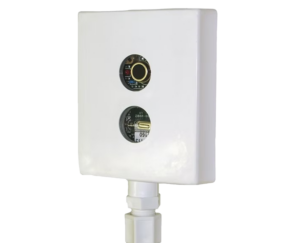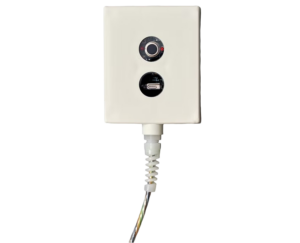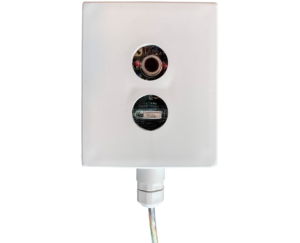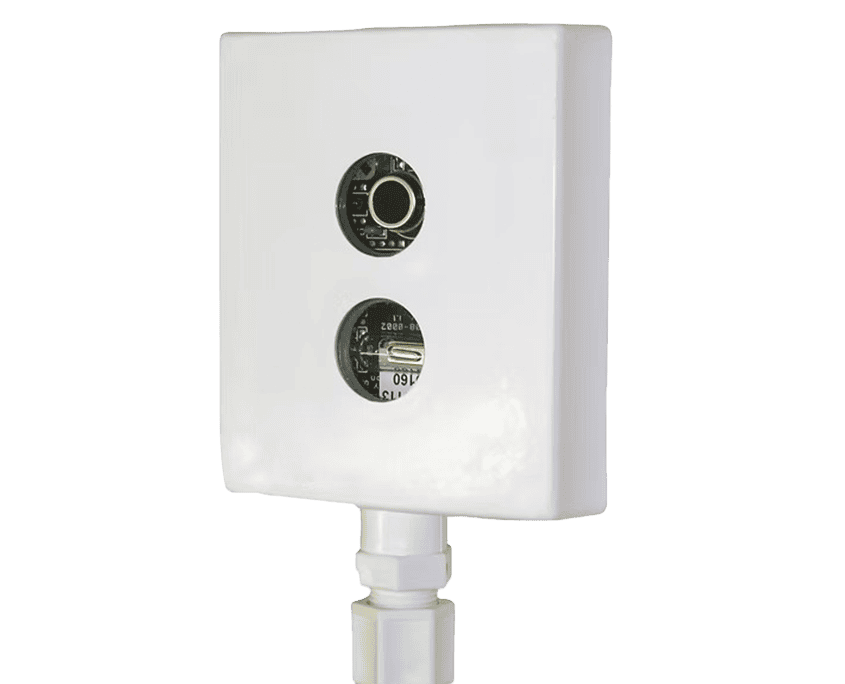
(DCR1-T1)
The Self-Testing DCR1-T1
All the capabilities of the standard DCR1 with self-testing capabilities.
(DCR1-T1)
All the capabilities of the standard DCR1 with self-testing capabilities.
The DCR1-T1 adds automated optical self-test to the standard DCR1 platform. Detection performance, chemical-resistant housing, and approvals are identical to the DCR1-S1.
This configuration is selected when detectors are installed in locations with limited physical access, when scheduled manual testing is disruptive or difficult to coordinate, or when facility specifications require ongoing automated verification of detector health.
The DCR1-T1 does not include FEP cable or enhanced relay connections.
If your project requires automated self-test without FEP cable or enhanced relay outputs, Sierra can help confirm the DCR1-T1 is the right configuration.
View available configurations, full product specifications, dimensions, and sensitivity ranges.
What is the difference between the DCR1-T1 and the DCR1-S1?
The DCR1-T1 adds automated optical self-test. Detection performance, housing, relay outputs, and approvals are identical to the DCR1-S1.
What does the self-test verify?
The self-test periodically checks the optical path and sensor functionality. Internal diagnostics also monitor input voltage, sensor circuits, relay integrity, and temperature.
Does the DCR1-T1 include FEP cable?
No. For the self-test configuration with FEP cable, see the DCR1-AT1. For self-test with both FEP cable and enhanced relays, see the DCR1-CT1.
Is the DCR1-T1 approved for hazardous locations?
Yes. Class 1 Division 2, Groups A, B, C, D, T4. Also Class 1 Zone 2.
What is the operating temperature range?
Operating: −40°C to +85°C. Humidity: up to 90%.
What are the dimensions?
Housing dimensions are 3.4 × 4.2 × 1.0 inches. Relay outputs rated 1.0 A at 30 VDC resistive. Input voltage 12–32 VDC (typically 24 VDC).